

The good news first: most sciatica from a disc gets much better without surgery.
Sciatica is pain that runs from your low back or buttock down the back of your leg, sometimes with numbness or tingling. The most common cause is a disc in the low back that bulges and presses on, or irritates, a nerve root. It can make sitting, walking, bending and even pulling on your socks hard.
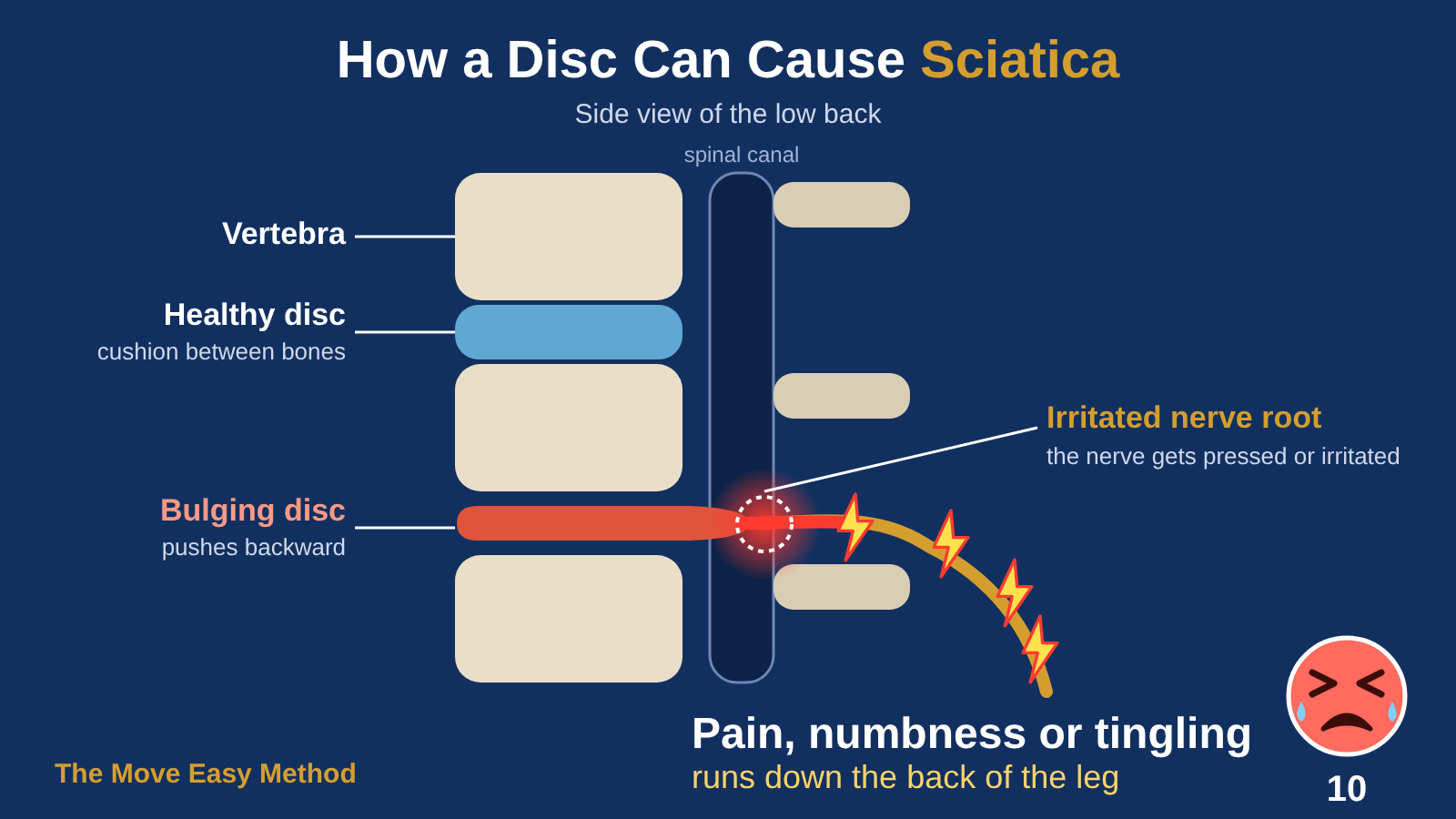
Diagram of a herniated disc in the low back pressing on a nerve root and causing sciatica pain down the leg
In my Oak Park office, I see it often in adults over 40. Here's what the research says, what it means for your day, and the gentle approach that's helping one of my clients right now.
What the Research Says
Here's what the best medical studies show. (These come from PubMed, the National Library of Medicine's free database of research.)
Many disc herniations shrink on their own. A 2023 review of 31 studies (2,233 people treated without surgery) found the disc bulge was reabsorbed in about 70% of people, mostly within 6 months. Bigger, ruptured herniations shrank most often. (Zou 2023, Clinical Spine Surgery)
Movement is part of the answer. A 2021 review and expert consensus on nerve pain recommends exercise for sciatica, including stretching, strengthening, core stability and mind-body exercise like Tai Chi and yoga. (Zhang 2021, Frontiers in Medicine)
No single treatment wins. A 2025 review of 50 trials on long-lasting sciatica found that exercise with gentle nerve-gliding moves and hands-on spinal care were among the best for short-term leg pain, but the evidence was weak overall. (Zhu 2025, Journal of Pain)
Qi Gong and Tai Chi help back pain. In a 2025 review of 16 trials (about 1,175 people, mostly around 60 years old), Qi Gong improved how well people could do daily tasks; the effect on pain was smaller. A 2024 Tai Chi review of 10 trials found less pain and better function. (Yu 2025, J Orthop Surg Res; Kang 2024, PLoS One)
An honest note: the Qi Gong and Tai Chi studies were done on general long-lasting low back pain, not sciatica from a disc specifically. Not studied yet is not the same as doesn't work, but I want you to know the difference.
What This Means in Real Life
Time is on your side. For many people, the disc settles down over weeks to months. Your job is to help that healing along, not fight it.
Gentle beats forceful. Long bed rest and hard stretching into pain both tend to backfire. Small, pain-free movements every day keep blood and oxygen flowing to the area.
Watch your everyday positions. Long sitting, bending and twisting with a load, and lifting from the floor are common triggers. Change positions often, and bend from your hips, not your back.
Calm the whole system. Pain that won't quit winds up your nervous system and wrecks sleep. Slow breathing and better sleep turn the volume down so your body can repair.
Track it. Notice what you can do: walking, putting on socks, lifting. Those wins often show up before the pain fully fades.
Dr. Dan's Take
After 25 years of helping people with back pain, here's what I've learned: the disc is rarely the only problem. When one part of the back gets stuck, the parts around it work overtime, and the nerve gets more irritated.
Hua Tuo, the legendary physician who created one of the first Qi Gong sets, said it simply: a door hinge that's used never rusts. So we don't force the stuck part open. We get the whole body moving together again, gently.
One of my clients came to me with sciatica from a disc. His back pain was a 10 out of 10, walking was a struggle, and pulling his socks on was almost impossible. We started the Move Easy protocol: Qi Gong, slow breathing, relaxation and gentle movement therapy.
Four weeks later, his back pain is cut in half, from 10 to 5. Walking isn't a problem anymore. When he bends forward, his fingertips went from just above his knees to touching his shoes. Lifting is still hard, so that's what we're working on next. One client's results, still in progress. Everyone's different.
Qi Gong brings three skills together:
1. Breath: slow breathing switches your body into rest-and-repair mode.
2. Movement: gentle, pain-free motion keeps your Qi and blood flowing, so nothing gets stuck.
3. Focused mind: calm attention settles your nervous system and your spirit.
Flow, not force.
Try It Yourself
Watch the video, then try it with me. First, slow deep breathing, in and out, equally. Then stand with your toes pointing forward and your shoulders and hips lined up. Shift your weight very gently from side to side, and keep breathing. Side to side keeps your spine neutral, so it may be easier on a sore disc than swinging forward and back.
Go slowly, stay in a pain-free range, and stop if your leg pain gets worse. Check with your doctor first.
When to See a Doctor Right Away
Get medical care right away if you have:
New trouble controlling your bladder or bowels
Numbness in your groin or inner thighs (the "saddle" area)
Weakness that's getting worse, like a foot that drags or slaps
Pain with fever, unexplained weight loss, or after a fall or accident
Severe pain that keeps you up every night and isn't easing
Start Here
Try it free: my free 10-minute Qi Gong routine at https://themoveeasymethod.com/pain-stiffness-relief
Go deeper: Move Easy Back & Legs, my 8-week gentle Qi Gong class for back, hip and leg pain: https://themoveeasymethod.com/backandlegs
Local to Oak Park? Book a free consultation at my office: Local to Oak Park?
Call or text (708) 439-1205 to set up a free consultation at my office.
Education only, not medical advice. Check with your doctor before starting any new exercise.
References (from PubMed)
1. Zou T, et al. Incidence of spontaneous resorption of lumbar disc herniation: a meta-analysis. Clinical Spine Surgery. 2024;37(6):256-269. https://doi.org/10.1097/BSD.0000000000001490
2. Zhang YH, et al. Exercise for neuropathic pain: a systematic review and expert consensus. Frontiers in Medicine. 2021;8:756940. https://doi.org/10.3389/fmed.2021.756940
3. Zhu Z, et al. Effectiveness of non-surgical interventions for patients with chronic sciatica: a systematic review with network meta-analysis. Journal of Pain. 2025;33:105431. https://doi.org/10.1016/j.jpain.2025.105431
4. Yu D, et al. Effect of qigong on pain and disability in patients with chronic non-specific low back pain: a systematic review and meta-analysis. Journal of Orthopaedic Surgery and Research. 2025;20(1):194. https://doi.org/10.1186/s13018-025-05576-8
5. Kang H, et al. Effects of different parameters of Tai Chi on the intervention of chronic low back pain: a meta-analysis. PLoS One. 2024;19(7):e0306518. https://doi.org/10.1371/journal.pone.0306518
