

Vacuum cupping, The Move Easy Method
Many people with long-term neck, shoulder or back tightness find that hands-on treatment, stretching or exercise helps, but the tightness keeps coming back. Understanding how vacuum cupping works, and how it fits with other approaches, can explain why combining methods often works better than any one alone.
What makes cupping different
Most hands-on therapies press down on tissue. Cupping does the opposite: it lifts. A cup placed on the skin creates gentle suction that pulls the skin, fascia and muscle up and apart. This gives tight, stuck tissue a kind of stretch it can't get from pressing, stretching or exercise [1].
How cupping works
1. Decompression. Suction lifts and separates the layers of skin, fascia and muscle. Researchers believe this changes the local tissue structure and helps muscles relax, which may help layers glide again after years of tension, poor posture or old injuries [1].
2. Blood flow. Studies using laser Doppler and near-infrared measurements show increased skin blood flow and better small-vessel circulation after cupping, bringing oxygen and nutrients to tight tissue [2, 3].
3. Pain signal reset. The strong new sensation competes with pain signals traveling to the brain, a process described by the pain-gate theory [1]. In a trial of people with chronic neck pain, cupping raised the pressure pain threshold, meaning sore areas became less sensitive [4].
4. Nervous system calm. Many people feel deeply relaxed during cupping, which helps the body shift out of a guarded, protective state and into rest and repair.
What the research shows
Reviews of clinical trials have found that cupping reduces neck pain, including when it's added to other treatment [4, 5], and lowers pain in people with chronic back pain [6, 7] and other long-term muscle and joint pain [8]. The effects are strongest during and shortly after a course of treatment [7, 8], and back pain research links a greater number of sessions to better results [9]. Cupping is not a cure on its own, and results vary from person to person.
Better together: cupping, bodywork, stretching, Qi Gong and strength training
Each approach does something different for the body. Research on combined care shows the same pattern again and again: adding one approach to another tends to work better than either alone [10, 11, 12, 15].
Cupping lifts and decompresses. It loosens stuck tissue and calms sensitivity, opening a window where the body moves more easily. In one trial, people with chronic back pain who received cupping along with another treatment improved more than those who received the other treatment alone [10].
Bodywork and manual therapy compress and realign. Hands-on bodywork and manual therapies work the tissue and joints from a different direction. Reviews show that manual therapy combined with exercise reduces neck pain more than exercise alone [11, 12].
Stretching lengthens. Stretching pulls tissue longer while cupping lifts it apart, so together they address stiffness in two directions. In office workers with chronic neck and shoulder pain, four weeks of regular stretching reduced pain and improved function [13].
Qi Gong retrains movement and the nervous system. Slow, mindful movement with relaxed breathing teaches the body to use its new range without guarding. Qi Gong and similar mind-body exercise reduce chronic neck pain [14], and Qi Gong improves function in people with chronic low back pain, with added benefit when combined with other treatments [15, 16].
Personal training builds strength. Strength holds joints in good position and protects them. Strengthening exercise reduces chronic neck pain and disability [14], and strength training is among the most effective exercise types for reducing disability from chronic low back pain [17].
Passive treatments like cupping and bodywork create change. Active work like Qi Gong, stretching and strength training is what helps that change last. A simple way to think of it: loosen, correct, move, strengthen.
A typical cupping series
Because the effects build on each other, cupping is usually done as a short series rather than a single session [9]. In one neck pain trial, five sessions over two weeks produced meaningful improvement [4]. A common pattern is twice a week for the first two weeks, then once a week for two more weeks, often alongside stretching and exercise. After that, some people use it occasionally for maintenance.
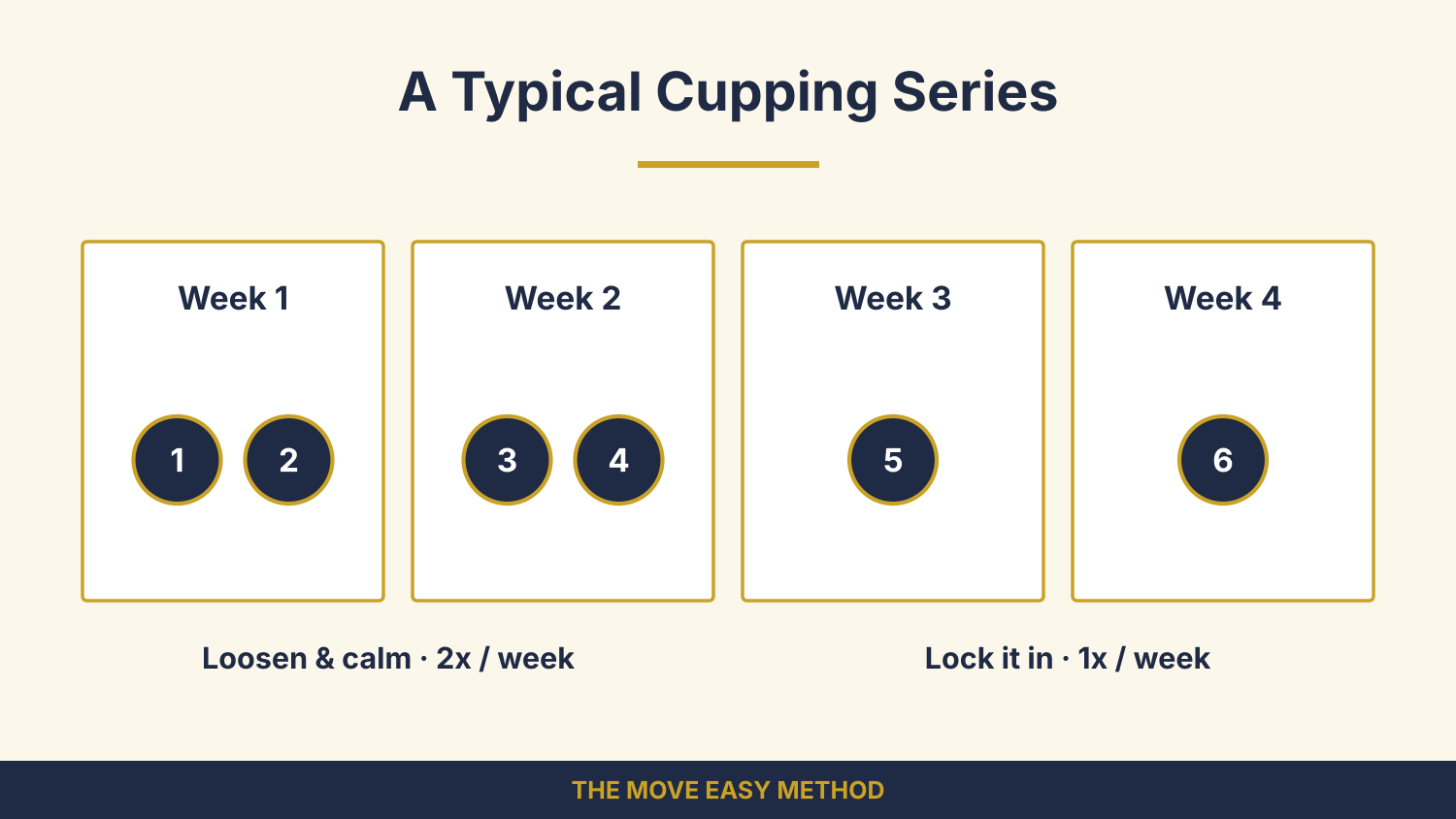
A typical cupping series, The Move Easy Method
What to expect
A cupping treatment usually lasts 10 to 15 minutes, and most people feel a strong but comfortable pulling. Round marks often appear where the cups were. They come from blood drawn up near the skin, are usually painless, and fade in about 3 to 10 days.
People who take blood thinners, are pregnant, or have a bleeding disorder, very fragile skin, open wounds or a history of blood clots should check with their healthcare provider before trying cupping.
– The Move Easy Method
Have questions about Qi Gong, assisted stretching or personal training programs? Book a free consultation here: https://calendly.com/drdan-themoveeasymethod/getting-started-call
References
1. Al-Bedah AMN, et al. The medical perspective of cupping therapy: effects and mechanisms of action. J Tradit Complement Med. 2019;9(2):90-97. https://doi.org/10.1016/j.jtcme.2018.03.003
2. Hou X, et al. Using laser Doppler flowmetry with wavelet analysis to study skin blood flow regulations after cupping therapy. Skin Res Technol. 2021;27(3):393-399. https://doi.org/10.1111/srt.12970
3. Karaman T, et al. Effect of dry cupping therapy on microvascular reactivity assessed by near-infrared spectroscopy and vascular occlusion test in healthy volunteers. J Bodyw Mov Ther. 2025;43:1-6. https://doi.org/10.1016/j.jbmt.2025.04.001
4. Cramer H, et al. Randomized controlled trial of pulsating cupping (pneumatic pulsation therapy) for chronic neck pain. Forsch Komplementmed. 2011;18(6):327-334. https://doi.org/10.1159/000335294
5. Kim S, et al. Is cupping therapy effective in patients with neck pain? A systematic review and meta-analysis. BMJ Open. 2018;8(11):e021070. https://doi.org/10.1136/bmjopen-2017-021070
6. Moura CC, et al. Cupping therapy and chronic back pain: systematic review and meta-analysis. Rev Lat Am Enfermagem. 2018;26:e3094. https://doi.org/10.1590/1518-8345.2888.3094
7. Zhang Z, et al. The effectiveness of cupping therapy on low back pain: a systematic review and meta-analysis of randomized control trials. Complement Ther Med. 2024;80:103013. https://doi.org/10.1016/j.ctim.2024.103013
8. Jia Y, et al. Effects of cupping therapy on chronic musculoskeletal pain and collateral problems: a systematic review and meta-analysis. BMJ Open. 2025;15(5):e087340. https://doi.org/10.1136/bmjopen-2024-087340
9. Shen WC, et al. Effectiveness of self-management of dry and wet cupping therapy for low back pain: a systematic review and meta-analysis. Medicine (Baltimore). 2022;101(51):e32325. https://doi.org/10.1097/MD.0000000000032325
10. Moura CC, et al. Effects of ear acupuncture combined with cupping therapy on severity and threshold of chronic back pain and physical disability: a randomized clinical trial. J Tradit Complement Med. 2022;12(2):152-161. https://doi.org/10.1016/j.jtcme.2021.07.008
11. Wilhelm M, et al. The combined effects of manual therapy and exercise on pain and related disability for individuals with nonspecific neck pain: a systematic review with meta-analysis. J Man Manip Ther. 2023;31(6):393-407. https://doi.org/10.1080/10669817.2023.2202895
12. Hidalgo B, et al. The efficacy of manual therapy and exercise for treating non-specific neck pain: a systematic review. J Back Musculoskelet Rehabil. 2017;30(6):1149-1169. https://doi.org/10.3233/BMR-169615
13. Tunwattanapong P, et al. The effectiveness of a neck and shoulder stretching exercise program among office workers with neck pain: a randomized controlled trial. Clin Rehabil. 2016;30(1):64-72. https://doi.org/10.1177/0269215515575747
14. de Zoete RMJ, et al. Comparative effectiveness of physical exercise interventions for chronic non-specific neck pain: a systematic review with network meta-analysis of 40 randomised controlled trials. Br J Sports Med. 2021. https://doi.org/10.1136/bjsports-2020-102664
15. Li H, et al. Baduanjin exercise for low back pain: a systematic review and meta-analysis. Complement Ther Med. 2019;43:109-116. https://doi.org/10.1016/j.ctim.2019.01.021
16. Yu D, et al. Effect of qigong on pain and disability in patients with chronic non-specific low back pain: a systematic review and meta-analysis of randomized controlled trials. J Orthop Surg Res. 2025;20(1):194. https://doi.org/10.1186/s13018-025-05576-8
17. Fernández-Rodríguez R, et al. Best exercise options for reducing pain and disability in adults with chronic low back pain: Pilates, strength, core-based, and mind-body. A network meta-analysis. J Orthop Sports Phys Ther. 2022;52(8):505-521. https://doi.org/10.2519/jospt.2022.10671
